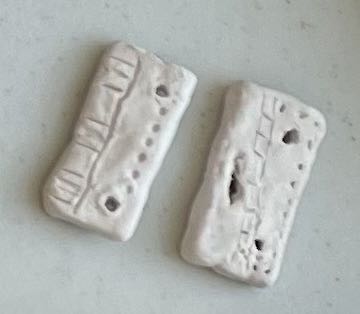
Wrist Clasp (Right)
Functions
The function of these items in Anglo-Saxon England is hardly in doubt: they were worn in pairs as closures for sleeves which were slit at the wrist; here they occur only in women’s graves. In Norway on the other hand (where they are of a slightly different design), not only are clasps found in male as well as female graves, but it is clear that they were used in a wider range of functions, for example, to fasten women’s dresses and men’s trouser bottoms.
The distributions and types of the wrist clasps
These small items certainly are unknown in southern England and Wessex, where any occurrences can only be attributed to imports from farther north. According to Archaeologia, the most widespread is formed of a pair of small, oblong plates of sheet-bronze, often perfectly plain, but quite frequently decorated with embossed spots of various sizes and in various combinations
Process of making
In order to make it, I used the clay in Makerspace and cut a piece of clay from the original clay bars. After that, I used the art knife to shape that piece of clay into a rectangle. And then I met the most challenging part: using small scrapers, tweezers, and awls to crave the decorative design and some holes on the surface of the plate clay.
What I gained from the making process
The making of wrist clasps and the recreation of how people wore the wrist clasps largely helped me to understand how wrist clasps used to close the sleeves or the pure literal description might be so abstract that we cannot imagine the functions of clasps. And I figured that the difficulty of creating these small and tiny items.